
Do I need a custom app, or will a website do the job?
Quick answer
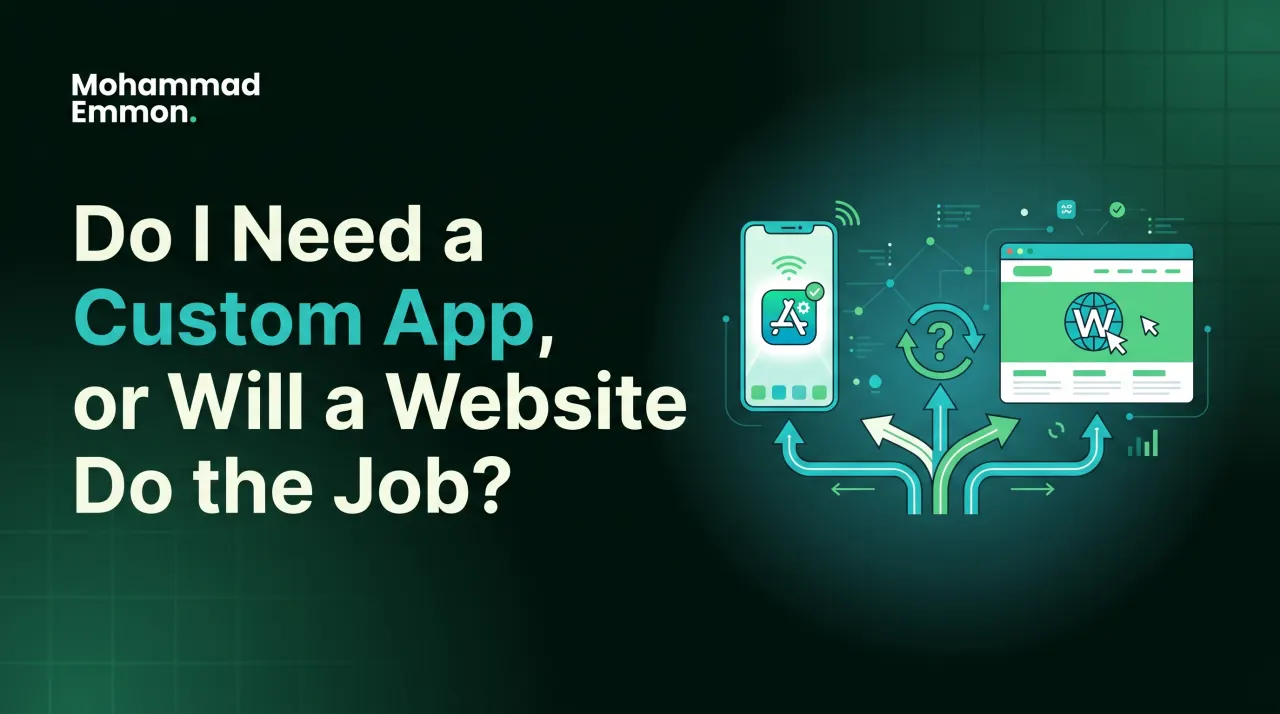
You need a custom app only when a website genuinely cannot do the job. If what you need is to explain your business, show your work, and let people contact or book you, a website does the job — and does it more cheaply and simply than an app. If you need logins, ongoing data specific to each user, or a workflow that runs entirely inside the product itself, you need a custom app with its own backend. Most businesses that think they need an app actually need a well-built website with a few smart features.
Key takeaways
- A website with the right features covers most business needs — an app is a bigger, more specific commitment.
- Logins, per-user data, and internal workflows are the real signals you need an app.
- A dynamic platform with a backend and CMS can sit between the two and often covers it.
- Starting with a website and growing into an app later is a normal, sensible path.
On this page
- Start with what the visitor actually needs to do
- When you genuinely need an app
- The middle ground people miss
- What this means for you
- The real difference between a website and a custom app
- Questions that reveal which one you need
- Why people over-estimate what they need
- What a dynamic website can already do
- When a true custom app is genuinely worth it
- The ongoing cost people forget to plan for
- A staged approach that avoids the wrong bet
- Common mistakes when deciding on a custom app
- What a proper discovery conversation covers
- Signs you're talking to the right developer
- What happens if you build too much, too soon
- How security differs between a website and a custom app
- A short list before you decide
- Do you actually need a custom app?
Start with what the visitor actually needs to do
Most businesses that ask about building an app actually need a website. One that explains what they do, shows their work, and makes it easy to get in touch. That covers the large majority of what a business site needs to achieve, and it's a simpler, cheaper, and faster path to being live.
When you genuinely need an app
The real signal is logins, data that's specific to each user, or a workflow that has to run entirely inside the product. If people need an account, a dashboard, or ongoing interaction beyond reading and contacting you, that's when a custom app with its own backend earns its cost.
It's worth being honest about which of these actually applies. "It would be nice if customers had accounts" is different from "customers need accounts to function" — the first can often wait, the second usually can't.
The middle ground people miss
A dynamic platform covers a lot of what people assume needs a separate app. That means a website with a full backend and a CMS you can actually use. If it lives on the web, it can usually be built this way, which is simpler to maintain and cheaper to run than a standalone app.
This middle path handles logins, simple dashboards, and custom workflows. You skip app store submissions, separate mobile codebases, and the ongoing maintenance a true app requires.
What this means for you
If you're unsure, start by describing what a visitor actually needs to be able to do — not what would be impressive to have. The answer to that question, more than any trend, tells you which path actually fits.
The real difference between a website and a custom app
People often use "app" loosely, to mean anything modern and interactive. A custom app, in the sense that actually matters for cost and complexity, means something with its own backend: user accounts, data specific to each person, and logic that runs continuously behind the scenes, not just pages that display content.
A website, even a sophisticated one, mainly displays information and collects it through forms. A custom app manages ongoing state — what a specific user has done, what they're allowed to see, what happens next based on their actions. That distinction, not how modern the site feels, is what actually separates the two.
Questions that reveal which one you need
Does a visitor need to log in and see something different from the last visitor? Does the site need to remember state between visits — an order in progress, a saved preference, a running balance? Does something need to happen automatically based on user behaviour, without a person manually triggering it? A "yes" to any of these points toward a custom app. A site of "no, no, no" almost always means a well-built website is the right, cheaper answer.
Write your honest answers down before talking to anyone about a build. It keeps the conversation grounded in what you actually need, rather than in what sounds impressive to describe.
Why people over-estimate what they need
"App" carries a certain prestige that "website" doesn't, even when a website would serve the exact same purpose. Wanting to look modern and serious is understandable — but it's not a reason to pay for infrastructure your business doesn't actually use.
The costlier version of this mistake is building the app anyway, then discovering the login system and dashboards go mostly unused because customers just wanted quick information and a way to get in touch. That gap between what got built and what customers actually wanted is expensive, and avoidable with an honest conversation before development starts.
What a dynamic website can already do
Modern websites can do far more than people expect. Booking systems, member logins, simple dashboards, automated emails, custom forms with real logic behind them — a well-built dynamic site handles all of it, on simpler, cheaper infrastructure than a standalone app requires.
This middle ground covers most of what businesses actually mean when they say "app." Before assuming you need a full custom application, it's worth checking whether a dynamic website already gets you there — often it does, at a fraction of the cost and ongoing complexity.
When a true custom app is genuinely worth it
Some businesses do need one. A platform with real, ongoing user-to-user interaction. A service where the core product only exists once a user is logged in and using it — not content someone reads, but a tool someone operates. Complex logic specific to your business that no off-the-shelf system, and no dynamic website, can reasonably replicate.
In these cases, the custom app isn't overkill — it's the product itself. The cost reflects real, necessary engineering, and trying to squeeze that into a simpler website would mean shipping something that doesn't actually do the job.
The ongoing cost people forget to plan for
A custom app doesn't stop costing money at launch. Hosting for a backend and database, ongoing security patching, and a developer available when something breaks are all standing costs a simple website doesn't carry to the same degree. Before committing to a custom app, plan the year-two and year-three cost, not just the cost of getting it built.
This isn't a reason to avoid a genuinely necessary app. It's a reason to be honest about the total cost of ownership before choosing that path over something simpler that might do the job just as well.
A staged approach that avoids the wrong bet
If you're not certain a custom app is needed, start with the dynamic website version of the idea. Build it, launch it, and watch how people actually use it. If it turns out real user accounts and continuous backend logic are genuinely necessary, you'll know with evidence, not a guess made before a single customer touched anything.
This staged path costs less upfront and de-risks the bigger investment. Plenty of businesses discover the simpler version was all they ever needed. Others confirm the custom app is worth it — with real usage data backing the decision instead of intuition alone.
Common mistakes when deciding on a custom app
Building for scale you don't have yet is the first. Designing a system for ten thousand users when you have thirty means paying now for a problem you may never have. Build for where the business actually is, with room to grow, not for a hypothetical future that may not arrive on schedule.
Copying a competitor's app without checking whether the underlying need is the same is the second. Their app might genuinely need real accounts and logic. Your business might not. Look at what your customers actually need to do, not at what a competitor happened to build.
Treating "modern" as a requirement rather than a feeling is the third. A fast, well-designed website feels modern too. The custom app label doesn't automatically confer that feeling, and a slow, clunky app feels far less modern than a fast, simple site.
What a proper discovery conversation covers
Before committing to a custom app, a real conversation should cover specifics. What does a user actually do inside the product, step by step? What data has to persist between visits, and why? What happens automatically, without a human involved, and what actually requires that automation? Who are the users — are they your customers, your staff, or both?
These answers usually reveal, quickly, whether the underlying need is genuinely app-shaped or website-shaped with some added features. Skipping this conversation is how businesses end up building the wrong thing at the wrong cost.
Signs you're talking to the right developer
A developer worth trusting on this question will sometimes talk you out of a custom app. If every conversation ends with "yes, you need a full custom build," regardless of what you actually described, that's worth questioning. The right answer sometimes is a website. A developer who never reaches that conclusion may be pricing to the bigger project, not to your actual need.
The reverse matters too. If your use case is genuinely app-shaped — real accounts, ongoing logic, data that has to persist — a developer who pushes you toward a simpler website anyway isn't doing you a favour either. You want an honest read of your specific situation, not a default answer in either direction.
What happens if you build too much, too soon
An oversized custom app built before it's needed carries real ongoing cost: more expensive hosting, more surface area to secure, more code to maintain, and often a slower path to actually launching because there's simply more to build. None of that helps a business that's still working out what customers actually want.
The businesses that get this right tend to start smaller than they expect to need, launch faster, and add real complexity only once usage data proves it's genuinely required. That approach protects both the budget and the timeline, without closing the door on building more later.
How security differs between a website and a custom app
A custom app usually holds more sensitive data. User accounts, personal details, sometimes payment information. That means more responsibility, not less. Authentication has to be built correctly. Data has to be stored securely. Access controls need real thought, not an afterthought.
A website has a smaller attack surface by comparison, simply because there's less sensitive data sitting behind it. That doesn't mean a website needs no security. It means the stakes and the specific risks are different, and any custom app decision should include a real conversation about how user data gets protected, not just how the product works.
A short list before you decide
Does the product only work once someone is logged in? Does it need to remember something specific to each user across sessions? Does something need to run automatically in the background? Would a fast, well-built website genuinely fail to do the job? If most answers are yes, a custom app is likely the right call. If most are no, you probably don't need one — and that's a good outcome, not a disappointing one.
Revisit this list honestly, ideally with someone who isn't trying to sell you the bigger, more expensive option. The goal is the right tool for what you're actually building, not the most impressive-sounding one.
A short, honest conversation up front is far cheaper than discovering the answer six months into a build that turned out to be the wrong shape for what the business actually needed. It costs nothing but time, and that time pays for itself many times over once real development work begins.
None of this is about talking anyone out of ambition. It's about matching the tool to the actual job, so the money and time going into a build go toward something the business genuinely needs, rather than toward a label that sounds more impressive on a pitch deck.
If you're still unsure after going through all of this, that's a completely normal place to land, and it's worth saying so plainly in the first real conversation with whoever might build it. A developer who genuinely wants to get this right will help you work through the uncertainty using your specific situation, not a generic checklist. That conversation, more than any article, is where the real answer usually surfaces. Bring your honest uncertainty to it, not a firm answer you feel obligated to defend. There is no wrong starting point in that conversation, only an honest one.
That honesty is worth more than a polished pitch either way. It helps a founder decide what to build. It helps the person you eventually hire build the right thing with you — whether the final answer turns out to be a simple website, or a genuinely custom app built for exactly what your business needs.
Do you actually need a custom app?
A custom app earns its cost when it removes real manual work, not when it just looks more impressive. If you would rather hand it to a specialist, see my website design & development service. For an authoritative reference, read the official WordPress developer resources.
Free security check
Worried your site is infected?
Get a free security check — I'll tell you if your WordPress site is compromised and exactly what it needs. No obligation.
Follow-up questions
People also ask
Yes. A dynamic platform with a full backend and CMS can handle logins, dashboards, and custom workflows without being a separate mobile app. Many businesses that assume they need an app actually need this instead.
Generally yes, because it's solving a more specific, ongoing problem. That's exactly why it's worth checking whether a website can do the job first.
Genuine, ongoing user-specific data or logic that a website can't reasonably replicate. If you can describe what you need without using the word "login" or "account," it's probably not a true custom app.
Often, yes, especially if it's been built with that possibility in mind from the start. It's one of the advantages of starting simpler: you're not locked out of growing into more complexity later.
Only if built as a native mobile app, submitted to Apple's or Google's app stores. Many businesses that assume they need this actually need a web-based dynamic platform instead, which skips that entire process.
Check whether it requires a login and tracks something specific to you across visits. If it's mostly information with a contact form, it may just be a well-built website labelled "app" in their marketing.
Related
Take it further.

Written by
Mohammad Emmon
WordPress Malware Removal, Security, Ongoing Security Monitoring And Website Development
I'm a WordPress malware removal and security specialist — I've cleaned and secured over 10,000 sites. Once a site is safe, I can also build, run and automate the whole thing. Based in Dhaka, working worldwide.
Keep reading