
Do I need a developer, a freelancer, or an agency?
Quick answer
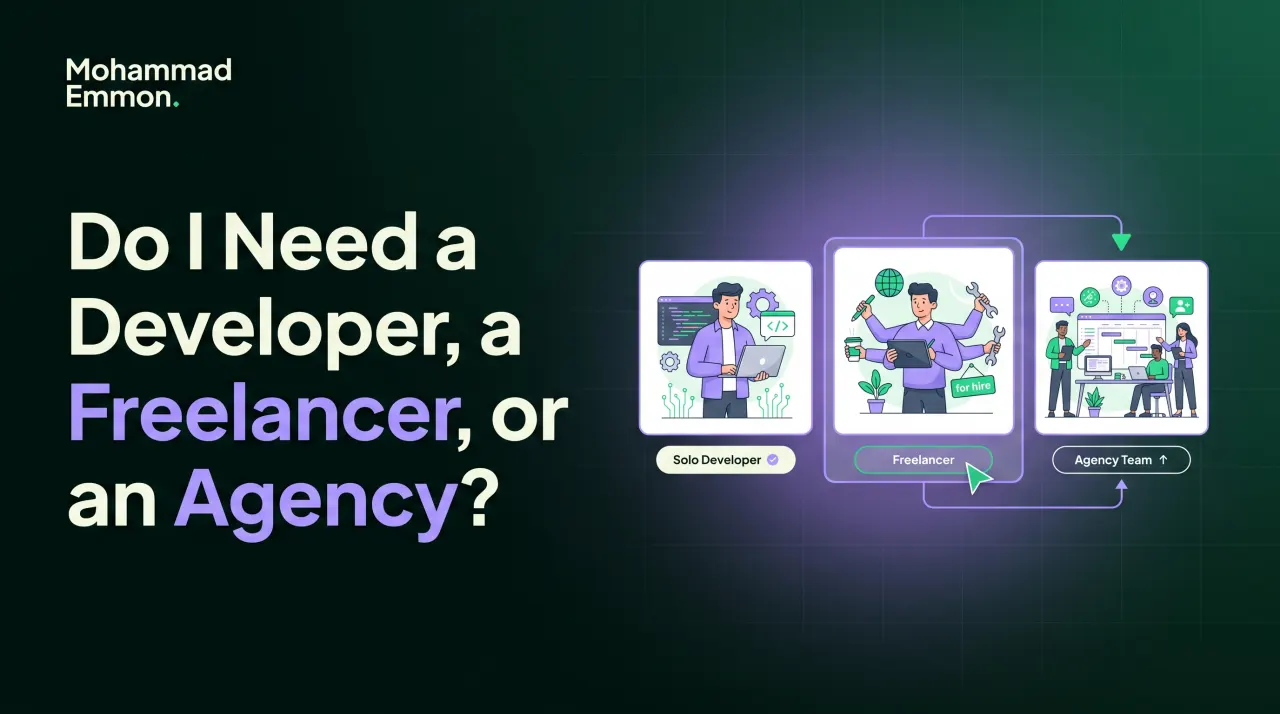
The developer vs freelancer vs agency debate misses the point: the label matters less than the person. Most businesses don't need five vendors — they need one person who owns it. A developer alone can't handle design or content. A freelancer often disappears after the project ends. An agency adds hand-offs and account managers between you and the actual work. What most businesses actually need is one accountable person who owns the whole outcome — the build, the content, and the security — from the first idea to the site staying online a year later.
Key takeaways
- A developer alone typically can't cover design, content, and ongoing security.
- Freelancers often disappear once the immediate project ends.
- Agencies add hand-offs — where projects die, and where "who owns this?" quietly eats your week.
- One accountable person removes the hand-offs and owns the whole outcome, start to finish.
On this page
- The problem with all three
- What actually replaces them
- How it actually works
- What this means for you
- When a developer alone genuinely makes sense
- When a freelancer is genuinely the right call
- When an agency is genuinely the right call
- Questions worth asking before you hire any of the three
- Red flags specific to each option
- How communication and turnaround actually differ
- What the relationship looks like after two or three years
- Does "one accountable person" really scale to your business?
- How pricing conversations tend to differ
- The one question that cuts through all of this
- A simple way to decide
- How reference checks differ across the three
- What changes when your site needs ongoing content, not just a build
- What good handovers look like, whichever way you choose
- Developer vs freelancer vs agency: my honest advice
The problem with all three
Most businesses don't need five vendors. They need one person who owns it. You've felt it — a developer here, a designer there, someone for content, and someone else entirely when the site breaks. Every hand-off is your time, your follow-up, your risk.
Each of the usual three options solves part of the problem while introducing a different one. A developer alone typically can't cover design or ongoing content. A freelancer solves the immediate project but often isn't there for what comes after. An agency brings more resources but usually adds layers between you and the actual work — an account manager relaying to a developer you never speak to directly.
What actually replaces them
One accountable person beats a team of five you have to manage. Hand-offs are where projects die — where the developer blames the designer, where "who owns this?" quietly eats your week. Removing the hand-offs means you get one person who owns the whole outcome, from the first idea to the site staying online a year later.
This isn't about doing everything superficially. It's about one person covering build, content, and security deeply enough that nothing falls into the gap between two specialists who each assume the other is handling it.
How it actually works
You talk to me in your own time — a call or a WhatsApp message. I scope it, I build it, and I keep it running. Build, grow, automate, secure — same person, start to finish. No team for you to hire, brief, chase, or manage.
What this means for you
Before hiring, ask who will actually own the outcome if something goes wrong after launch. If the honest answer is "it depends who you can reach that week," that's worth weighing against the alternative of one person who owns it, start to finish.
When a developer alone genuinely makes sense
Sometimes the developer vs freelancer vs agency question has an easy answer. Your brand already exists. Your design is locked. Someone handed you a finished file, or your old site just needs rebuilding on better foundations. What you need is technical execution. Not vision, not content, just clean build work.
In that case, a developer alone can be the right call. You're not paying for creative direction you don't need. You're paying for clean code and sensible architecture. Someone who won't rebuild the same page five times chasing a look. The catch shows up after launch. Most developers aren't set up to write your content. Most don't think much about ongoing growth either. You need a plan for that gap before you start.
It's worth being specific about what "just execution" means in practice. It means a fixed brief, a clear spec, and no open design questions left hanging. If any of those are missing, the hire changes shape. A developer-only hire quietly turns into a design project. Nobody signed up to run that project.
When a freelancer is genuinely the right call
A freelancer earns their reputation for a reason. For a single, bounded project, a freelancer can be fast and cheap. Think a landing page, a one-off fix, or a short sprint before a launch date. You don't need a long relationship. You need a task done and closed.
This is where the developer vs freelancer vs agency comparison tips clearly toward the freelancer. Low stakes, short timeline, a clear finish line. Where it breaks down is anything with a life after delivery. A site that needs updates. Content that needs to grow. Security that needs watching. A freelancer who was perfect for the sprint often isn't built for the marathon.
The tell is usually in how the engagement is scoped from day one. If the freelancer only talks about the deliverable, that's worth noting. Never mentioning what happens next isn't a red flag by itself. It just means you need a separate plan for everything after delivery.
When an agency is genuinely the right call
Agencies get unfairly flattened in a lot of "hire one person instead" arguments. That's not fair to the cases where an agency is actually correct. A large enterprise with layered compliance requirements often needs a bench, not an individual. Multiple stakeholders, simultaneous workstreams across legal, design, and engineering — that's real complexity.
Some projects genuinely require ten specialists working in parallel under one roof. No single person can replace that setup. That's not a developer vs freelancer vs agency failure. That's matching scale to scale. The honest test is whether your business actually has that complexity. Or whether it just feels that way because nobody's organized it yet. Most small and mid-sized businesses haven't hit that threshold, even when it feels urgent.
A useful gut check: count the actual decision-makers your project needs to satisfy at once. One or two people means you probably don't need agency-scale coordination. Five or more, across departments, and an agency's structure starts to earn its overhead.
Questions worth asking before you hire any of the three
Whichever direction you lean, ask the same handful of questions first. Who exactly will do the work? The person in front of you, or someone you'll never meet? What happens the week after launch if something breaks? Is there a retainer, or does every request start a new quote from zero?
Ask to speak to whoever actually writes the code. Not just whoever manages the account. Ask how they've handled a client relationship past year one. Most won't have a clean answer. These questions cut through the developer vs freelancer vs agency decision faster than any pitch deck. The answers are hard to fake convincingly.
Write the answers down before you compare options. It's easy to remember the pitch and forget the specifics. A week later, a few conversations start to blur together.
Red flags specific to each option
Each path has its own warning signs. With a freelancer, the flag is availability. Check whether they answer messages after the invoice is paid. A freelancer who goes quiet post-launch is a pattern, not a one-off. With a solo developer, watch for a portfolio that's all code and no outcomes. No sense of how a site should read, convert, or get found.
With an agency, the flag is distance. If you never speak to the person actually building your site, that's structural, not a scheduling accident. Ask directly: will I talk to the builder, or to someone relaying to the builder? A vague answer here is itself the answer. Weighing developer vs freelancer vs agency options means testing for these specific failure modes. Not just comparing price.
How communication and turnaround actually differ
A freelancer usually replies fast during the project. Slower once it's delivered, once their attention moves to the next client. A developer working solo can be quick for code changes. Slower for anything needing design judgment, because that's not their instinct.
An agency often has the most structured communication. It also tends to have the slowest turnaround, because your request passes through more people first. None of these are wrong by default. They're trade-offs. The developer vs freelancer vs agency choice comes down to which trade-off you can live with. Especially when something's urgent and you need an answer today, not next week.
Test this before you commit, not after. Send a real question during the sales process and time the reply. That single data point tells you more than any promise about response times ever will.
What the relationship looks like after two or three years
This is where the differences show up most. A freelancer relationship often fades. They move to bigger clients, or you outgrow their scope. A developer-only relationship can stall in a different way. The code stays maintained, but the content and positioning stop evolving.
An agency relationship can survive for years. But you may cycle through several account managers and developers behind the scenes, without ever noticing the handoffs. Ask what a three-year client relationship has actually looked like, for each option you're considering. Not what they promise — what's actually happened. That question exposes more about the developer vs freelancer vs agency decision than any sales conversation will.
Does "one accountable person" really scale to your business?
It's fair to ask whether one person can genuinely replace three. The honest answer: it depends on what your business needs. Not on what sounds appealing in a pitch. You might need one coherent site, built well and kept secure over years. One accountable person can cover that fully. I've built and maintained sites this way for years. That work sits behind over 10,000 WordPress sites cleaned and 573+ businesses secured.
If you genuinely need five specialized workstreams running in parallel on a compliance-heavy build, no single person replaces that team. The real test isn't ideology. It's matching the shape of the work to the shape of the provider. Most businesses overestimate their complexity. They end up paying agency overhead for developer-sized problems. That's exactly why the developer vs freelancer vs agency question deserves an honest answer, not a default one.
A returning client base is one signal worth trusting here. A 96% client return rate doesn't happen if the one-person model quietly fails once things get complicated — it happens because most small-business complexity is smaller than it feels from the inside.
How pricing conversations tend to differ
A freelancer usually quotes per project. Simple, but every new request restarts the negotiation. An agency usually quotes per phase or retainer tier. More structure, but more overhead baked into the number too — you're paying for coordination as well as the build.
A developer working alone tends to price closer to the actual hours the work takes. Less padding for internal coordination that doesn't exist. None of these structures is inherently better. What matters is whether the pricing model matches how you'll actually use the relationship. The developer vs freelancer vs agency pricing conversation should follow your usage pattern, not the other way round.
The one question that cuts through all of this
Strip away every other consideration and one question does most of the work. If something breaks at 9pm on a Friday, who picks up? With a freelancer, it might be nobody until Monday. With an agency, it might be a support queue before it reaches an actual engineer. With a developer alone, it depends entirely on that person's availability.
Ask this before you sign anything, whichever way you're leaning. The honest answer tells you more about fit than any portfolio will. It's the fastest way to settle a developer vs freelancer vs agency decision when everything else on paper looks roughly equal.
A simple way to decide
Start with the actual scope. A single short task with a firm end date usually suits a freelancer. A technical rebuild with design and content already settled usually suits a developer. Genuine multi-team complexity, with real compliance demands, usually suits an agency.
Everything else is where one accountable person tends to outperform all three defaults. The ongoing, evolving, needs-to-stay-secure majority of small business websites. That's not a sales pitch. It's just where the hand-offs stop costing you time. Decide the developer vs freelancer vs agency question by scope first. Then by who's still answering your messages in year three.
How reference checks differ across the three
A freelancer reference is usually one finished project. Ask what happened after delivery, not just how the launch went. A developer reference should show a site that's still evolving, not frozen in time. An agency reference should include the actual builder's name, not just the account team.
Call the reference if you can. A five-minute call surfaces more than a written testimonial ever will. Ask one blunt question: would you hire them again today? The answer settles more of the developer vs freelancer vs agency decision than any portfolio page.
What changes when your site needs ongoing content, not just a build
A one-time build is a different job from an ongoing site. Blogs, case studies, and landing pages need someone who keeps writing after launch. A freelancer's contract usually ends at delivery. A developer alone rarely offers content as part of the deal.
An agency can staff a content function, but it adds another layer to manage. Another person to brief. Another voice to keep consistent with your brand. The developer vs freelancer vs agency question often quietly turns into a fourth hire. Nobody budgeted for that, unless one person already covers it.
What good handovers look like, whichever way you choose
Even the best fit needs a proper handover at the start. Access to hosting, domain, and analytics should sit with you, not locked in someone else's account. Ask for admin credentials in your own name from day one. This matters equally for a freelancer, a developer, or an agency.
A good provider hands this over without being chased for it. A weak one stalls. Losing access is often their only real leverage to keep you paying. That single habit says more about trustworthiness than anything in a proposal. It's a small thing to check early. Ask about it before the developer vs freelancer vs agency decision is final. It costs you nothing, and it tells you a lot.
Developer vs freelancer vs agency: my honest advice
In the developer vs freelancer vs agency choice, accountability matters more than the size of the team. If you would rather hand it to a specialist, see my website design & development service. For an authoritative reference, read the official WordPress developer resources.
Free security check
Worried your site is infected?
Get a free security check — I'll tell you if your WordPress site is compromised and exactly what it needs. No obligation.
Follow-up questions
People also ask
It can feel that way, but a team usually means more hand-offs, not more accountability. When something goes wrong, having one person who owns the outcome tends to get it fixed faster than routing it through account management.
That's a common assumption, but web, content, and security overlap more than people expect — someone who started in the hardest corner, security, and grew from there can usually cover all of it without losing depth in any one area.
Look at the workstreams, not the budget. If you genuinely need legal, design, and engineering moving in parallel on a compliance-heavy build, that's agency territory. If it's one website that needs to be built well and kept running, it usually isn't. Most businesses that reach for an agency actually have a developer-sized problem.
Yes, and it happens often. A freelancer is great for a first version or a tight deadline. The friction shows up later, when nobody owns what happens after launch. It's worth deciding upfront who takes over maintenance, because that handoff is exactly where sites get neglected.
Ask to see a live site they built end to end, not just a code sample. Look at how the content reads and whether the layout still makes sense a year after launch. A developer with no design instinct usually has a portfolio full of technically fine sites that nobody would actually want to read.
It's a fair question and worth asking directly, not assuming. Ask what documentation exists, whether credentials and processes are recorded anywhere outside one person's head, and what continuity plan is in place. A serious solo provider should have a clear answer, not a shrug.
Related
Take it further.

Written by
Mohammad Emmon
WordPress Malware Removal, Security, Ongoing Security Monitoring And Website Development
I'm a WordPress malware removal and security specialist — I've cleaned and secured over 10,000 sites. Once a site is safe, I can also build, run and automate the whole thing. Based in Dhaka, working worldwide.
Keep reading