
Malware Removal & Security
372 Dental
WordPress malware removal against a payload that re-downloads itself from the blockchain
 Delivered by Mohammad Emmon
The problem
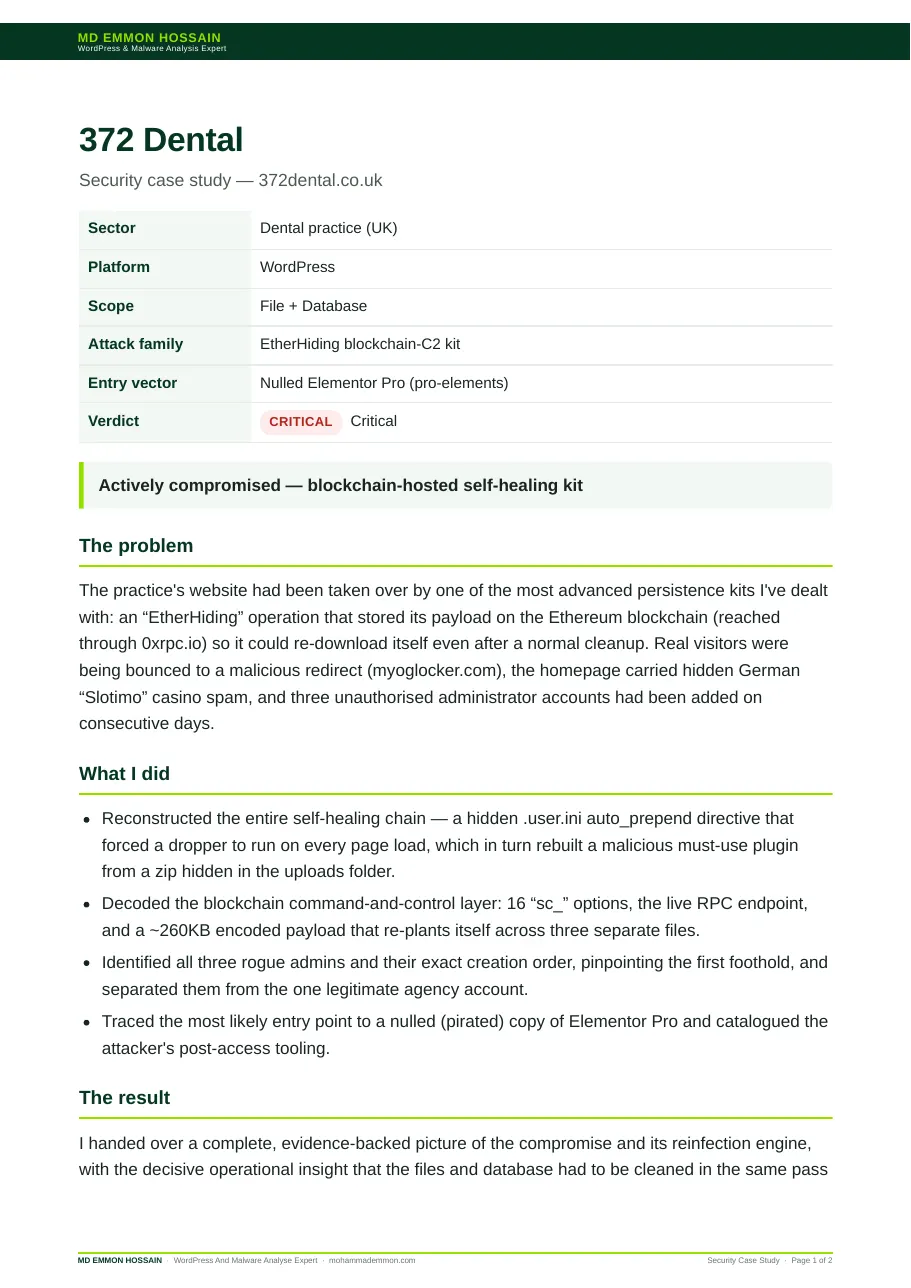
The practice's website had been taken over by one of the most advanced persistence kits I've dealt with: an “EtherHiding” operation that stored its payload on the Ethereum blockchain (reached through 0xrpc.io) so it could re-download itself even after a normal cleanup. Real visitors were being bounced to a malicious redirect (myoglocker.com), the homepage carried hidden German “Slotimo” casino spam, and three unauthorised administrator accounts had been added on consecutive days.
What I did
- Reconstructed the entire self-healing chain — a hidden .user.ini auto_prepend directive that forced a dropper to run on every page load, which in turn rebuilt a malicious must-use plugin from a zip hidden in the uploads folder.
- Decoded the blockchain command-and-control layer: 16 “sc_” options, the live RPC endpoint, and a ~260KB encoded payload that re-plants itself across three separate files.
- Identified all three rogue admins and their exact creation order, pinpointing the first foothold, and separated them from the one legitimate agency account.
- Traced the most likely entry point to a nulled (pirated) copy of Elementor Pro and catalogued the attacker's post-access tooling.
The result
I handed over a complete, evidence-backed picture of the compromise and its reinfection engine, with the decisive operational insight that the files and database had to be cleaned in the same pass — clean either half alone and the other re-plants it within the hour — followed by a full credential-rotation and hardening plan to break the cycle for good.
What it proves
A payload hosted on a blockchain cannot be deleted — only cut off. The win is mapping the whole chain so the client knows exactly which link to break.
Delivered by
Mohammad Emmon
WordPress Malware Removal, Security, Ongoing Security Monitoring And Website Development
I'm a WordPress malware removal and security specialist — I've cleaned and secured over 10,000 sites. Once a site is safe, I can also build, run and automate the whole thing. Based in Dhaka, working worldwide.
Worried about your site?